Edwina Mark, The Sinful One, Hillman, 1959
Showing posts with label collectible paperbacks. Show all posts
Saturday, January 25, 2014
Friday, November 15, 2013
Forgotten Books: His Brother's Wife -- Clay Stuart (Harry Whittington)
Now I have a copy of this book already. It was given to me years ago by Harry Whittington, who wrote it as "Clay Stuart." I'd never read it, but there is was on the shelf. I didn't need another one. Still, here's one for $3.95, and nobody wants it. Could I let it just go, unloved and unwanted? No, of course I couldn't. So I bid $3.95, fully expecting someone to overbid me and save me the money. Nobody did, so it was mine. I figured that must be a sign that I should read it, which I did almost as soon as it arrived.
The plot's a familiar one. There are two brothers, one of whom leaves the old homestead to seek his fortune, though he remains half owner. He returns to find that his brother is now married and a drunk who's let the place run down to almost nothing. Whit, the returning brother, decides to save the farm and falls for his brother's wife, who's been sleeping with the mortgage holder so she and her husband can stay on the farm when he forecloses. Living there also are the old family retainer and his sexy daughter. And then there's Whit's fiancee who shows up so Whit can rape her. That's right. I guess you have to remember that this is 1964 and the sympathetic protagonist can do that kind of thing, especially in a Beacon book. And of course it turns out that the fiancee loves it, so maybe that made it more acceptable 50 years ago. I have a feeling scenes like this one were fairly common in books of this type. This being 2013, however, it's repugnant any way you look at it. I wouldn't expect anybody to want to read the book, knowing ahead of time what was going to happen.
There's enough plot in this book for an another 100 pages, but Whittington wraps it all up (way too easily and quickly) in 154. As is typical of Whittington's work, the hackneyed plot becomes compulsively readable in his hands, but that one scene is so off-putting that I can't recommend the book.
Friday, March 22, 2013
Forgotten Book: I'll Find You -- Richard Himmel
Not many Gold Medal writers are forgotten, but Richard Himmel seems to be. A brief Google search turned up next to nothing about him or his books. I'm partially at fault here, since I've had a good many of them on my selves for well over 30 years and never read a one of them. Why? Well, you can't read everything. Anyway, I decided it was time to take a look at one. Himmel, after all, sold millions of books. His first one for Gold Medal was I'll Find You, and it was the second novel GM published. (The first was John Flagg's The Persian Cat, and Flagg is another GM writer whose work I've never read. So many books, so little time.)
What did I learn? For one thing, the Gold Medal pattern was set from the very beginning. I'll Find You has just about everything that the later books from this publisher had. The first-person narrator, Johnny Maguire, is a self-proclaimed punk, a night-school lawyer whose attitudes toward women are primitive at best: "OK, so she might have fought. It would have been good that way. Maybe that's what she wanted. Maybe she wanted to get messed up a little bit. Maybe that's the way it was good for her." He says this about a woman he's fallen for, hard. She's the first woman he's ever loved, though of course he's had plenty of sex. Sex is big in the GM line.
As soon as Maguire falls for the woman, she disappears, an apparent suicide. Maguire doesn't think she's dead and decides to find her. Hence the book's title. And he does find her. That's when things get complicated. Gangsters are involved, and there's a murder, but this isn't really a crime novel. In its own twisted way, it's a love story in the Gold Medal vein, with the emphasis on speed, with lots of raw emotion, with plenty of melodrama. And a really great final scene and line, very much in keeping with the character of Johnny Maguire.
Himmel had something going for him, and it's not a big surprise that the book was such a hit. My guess is that he didn't plan to make Maguire a series character. He wasn't cut out to be one. The book sold so many millions, however, that bringing him back must have proved irresistible. In one of the sequels, Maguire is even an investigator for the State Department. I guess I'll have to read another one to see how this came about.
What did I learn? For one thing, the Gold Medal pattern was set from the very beginning. I'll Find You has just about everything that the later books from this publisher had. The first-person narrator, Johnny Maguire, is a self-proclaimed punk, a night-school lawyer whose attitudes toward women are primitive at best: "OK, so she might have fought. It would have been good that way. Maybe that's what she wanted. Maybe she wanted to get messed up a little bit. Maybe that's the way it was good for her." He says this about a woman he's fallen for, hard. She's the first woman he's ever loved, though of course he's had plenty of sex. Sex is big in the GM line.
As soon as Maguire falls for the woman, she disappears, an apparent suicide. Maguire doesn't think she's dead and decides to find her. Hence the book's title. And he does find her. That's when things get complicated. Gangsters are involved, and there's a murder, but this isn't really a crime novel. In its own twisted way, it's a love story in the Gold Medal vein, with the emphasis on speed, with lots of raw emotion, with plenty of melodrama. And a really great final scene and line, very much in keeping with the character of Johnny Maguire.
Himmel had something going for him, and it's not a big surprise that the book was such a hit. My guess is that he didn't plan to make Maguire a series character. He wasn't cut out to be one. The book sold so many millions, however, that bringing him back must have proved irresistible. In one of the sequels, Maguire is even an investigator for the State Department. I guess I'll have to read another one to see how this came about.
Saturday, August 18, 2012
Thursday, May 24, 2012
Wednesday, January 25, 2012
Tuesday, January 24, 2012
Thursday, March 24, 2011
A Site of Possible Interest to Some Readers of this Blog
Comic Book Art Gallery: "This page is solely dedicated to sharing my collection of paperback cover art. This hobby is something I've very passionate about. Although my collection is made up of art from every decade from the 1940's through to the 2000's, my primary interest these days is in vintage covers from the 50's & 60's. The genres I'm most interested in pusuing art from are the 'Hardboiled Crime/Detective/Murder/Mystery genre, and also from the 'Good Girl Art' genre, many of which can be found in the horribly named 'sleaze' genre. But even beyond those genres, I'm interested and open to buying from most genres as long as the imagery speaks to me. I focus on art first, and artist's name second. While I do have my favorite artists and seek work by those men, I'm just as likely to buy covers from unidentified artists or artists whose name don't carry any 'cache' within the hobby. I focus is collecting 'paperback art first', and artists second. That is the precise reason why I've chosen to display my collection alphabetically by the name of the title, rather than by artist."
Friday, February 18, 2011
Thursday, February 17, 2011
Saturday, February 12, 2011
Friday, February 11, 2011
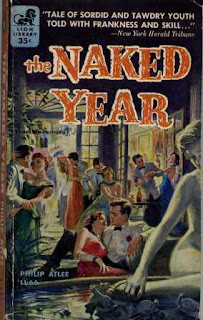
Forgotten Books: The Naked Year -- Philip Atlee
This is the Lion Books edition of Philip Atlee's 1940 novel The Inheritors. I'm not sure if it was published originally under the Atlee name or under Atlee's real name, James Atlee Phillips. As Philip Atlee, as we all know, he went on to write the Joe Gall series for Gold Medal. As you can tell from the cover, The Naked Year isn't a crime novel. It's a straight novel, sort of a hardboiled Gatsby, set in Fort Worth, Texas. When this book was published, Texas had just become an urban state, with more people living in cities t
han on farms. Writers many years later were still complaining about the fact that Texas writers continued to about the state as if it were rural (some of us are still doing that) instead of tackling the stories of people in the big urban environments. This book was way ahead of its time, according to A. C. Greene, who gave it a coveted spot in his 50 Best Books about Texas.

There's plenty of sensationalism if that's what you're looking for. Lots of drinking, sex (nothing overt), and abortion (sensational for the time the book was published, for sure). Excellent writing, and at least one truly disturbing scene when the thrill-seeking youth go out to the local city dump to shoot rats at night.
Anybody interested in Atlee's work in the Joe Gall books should certainly take a look at this one to see where Atlee started.
Thursday, January 27, 2011
Monday, January 24, 2011
Subscribe to:
Posts (Atom)


iam Lindsay Gresham, Nightmare Alley, Popular Library, 1976.