
Thursday, August 17, 2017


I suspect the same goes for books
Millennials don’t really care about classic movies: A new study finds that less than a quarter of millennials have watched a film from start to finish that was made back in the 1940s or 50s and only a third have seen one from the 1960s.
Wednesday, August 16, 2017

On Endings -- Janet Hutchings, Editor of EQMM
ON ENDINGS | SOMETHING IS GOING TO HAPPEN: Recently I was asked to serve on a short-story panel at the Bouchercon World Mystery Convention in Toronto (October 12-15) that will attempt to provide advice to new writers on various aspects of craft. The panel’s moderator, frequent EQMM and AHMM contributor James Lincoln Warren, asked each panelist to provide a list of topics for discussion. That got me thinking about endings.


A Sports Car is Born
A Sports Car is Born: One measure of the desirability of a sports car is whether or not it has teenagers drooling over it before they’re even old enough to drive. Here’s the story of one of the most drool-worthy cars in auto history. (See how long it takes you to guess which car we’re talking about.)
When I was a kid, our next-door neighbor was a car salesman. I got to ride in the first one of these cars ever to appear in Mexia, Texas.
When I was a kid, our next-door neighbor was a car salesman. I got to ride in the first one of these cars ever to appear in Mexia, Texas.
Collecting Vintage Postcards
Collecting Vintage Postcards: Postcards (sometimes spelled out in two words as "post cards") became popular at the turn of the 20th century, especially for sending short messages to friends and relatives. They were collected right from the start, and are still sought after today by collectors of pop culture, photography, advertising, wartime memorabilia, local history, and many other categories.
Bonus FFB for Wednesday: Silence -- Thomas Perry
 This is a little bit of a cheat, since I don't usually write about books I don't finish, but I thought I'd make an exception just this once. It's rare for me not to finish a book once I've started, and I never thought I wouldn't finish one by Thomas Perry, who's entertained me many times. Silence didn't work for me, though.
I should have known it was trouble when I saw that it was well over 400 pages long with fairly small print. I'm not a fan of long books, but Perry's such an expert at pacing, I didn't think the length would be a problem. I was wrong.
Here's why. Perry seems to have intended this to be a character-driven thriller, which is fine, although I think thrillers are generally plot driven. I got bogged down in all the backstories for the characters in Silence. There's so much backstory in the first 120 pages (which is as far as I got) that there's enough material for a couple of other books. Maybe all this stuff will pay off later in the book, but not for me. The thing that drove me to put the book down was the lengthy backstory (eight or nine pages) of one character, who's then killed only a few pages later. I figured enough was enough. I'll be reading other Thomas Perry books, no question about that, but this one was a disappointment.
Tuesday, August 15, 2017
Writers Read: Bill Crider
Writers Read: Bill Crider: Crider's newest novel is Dead, to Begin With, the 24th Dan Rhodes Mystery.
Recently I asked the author about what he was reading.
B.K. Stevens: R.I.P.
Mystery Fanfare: B.K. Stevens: R.I.P.: Such sad and unexpected news. Bonnie Stevens: R.I.P. She will be missed by so many in the mystery community. Sending sympathy to her family and friends.
Song of the Day
This is the first recorded version. The Kingston Trio didn't have a hit with it, however.
(24) Let's Get Together - YouTube:
(24) Let's Get Together - YouTube:


Second Glance: ‘Cop Land’
Second Glance: The Scorsese-esque Melancholy of ‘Cop Land’: James Mangold's 1997 police corruption drama boasts a jaw-dropping cast, headed up by a startlingly natural Sylvester Stallone.
Overlooked Movies: Bulldog Drummond (1929)
 Bulldog Drummond was made at the very beginning of the sound era and was Ronald Colman's first talkie. He was one of the lucky silent stars who had the right kind of voice for talkies, or for just about anything. In this movie he shows a talent for acting and a natural charm that made him a star in both silent and talking films.
This isn't true of everyone in the movie. Some of the acting seems stuck in another era (I found Lawrence Grant as Dr. Lakington especially annoying) as do some of the film-making techniques. Still, I enjoyed watching this.
Drummond is a demoblized officer who finds himself bored with life outside the military. He says he's too rich to work and wants excitement, so he places a newspaper ad offering his services in exchange for excitement. He gets a lot of responses, but the one he chooses comes from Phyllis Benton (Joan Bennett), who wants him to rescue her uncle from a hospital where he's supposedly being treated for a nervous breakdown. She believes something fishy is going on, and of course it is. The villains, dressed throughout in evening clothes, want the uncle's signature on a paper turning his worldly goods over to them. Drummond sets about the rescue, both helped and hindered by his friend Algy, the alleged comic relief, and by his valet.
There are escapes and pursuits and disguises, and it's all good fun up until the end when there's a gratuitous (to me) killing, in which the tone is all off. And then there's "the circus gag," which is pretty hard to swallow.
Many more Drummond adventures on film followed this one, but I believe that Colman was in only one more. This movie's nearly 90 years old now, and it holds up surprisingly well for the most part, especially Colman's acting, although I doubt I could convince any whippersnappers of this. I'm glad I watched it and recommend it for historical reasons if nothing else.
Monday, August 14, 2017

50 Essential Historical Fiction Books
50 Essential Historical Fiction Books: Whether or not you consider yourself a fan of historical fiction, you've heard the names Hilary Mantel, Eleanor Catton, Anthony Doerr and Kristin Hannah repeatedly over recent years. No longer dismissed as bodice-rippers rife with anachronisms or dreary textbooks dressed up in barely discernible plots, historical fiction is gaining the respect of critics and readers alike, regularly appearing on shortlists for major literary awards and on bestseller lists around the world.
Joseph Bologna, R. I. P.
The New York Times: Joseph Bologna, who looked like the quintessential tough guy but couldn’t seem to resist writing and playing sensitive male characters who longed for love and commitment in films like “Lovers and Other Strangers” and “Made for Each Other,” died on Sunday in Duarte, Calif., near Pasadena. He was 82.
Hat tip to Jeff Meyerson.
Hat tip to Jeff Meyerson.


The Great 78 Project
The Great 78 Project: The Internet Archive has a project going in an attempt to save as many old sound recordings as possible. These are songs recorded on 78 rpm records made between 1898 and the 1950s, when 33 and 45 rpm records replaced them.
Sunday, August 13, 2017
Samaritans -- Jonathan Lynn

How's he going to do that? To start with he's going to hire superstar doctors. To pay them, he'll have to cut costs elsewhere, but who cares about people in the low-paying jobs? It's the Big Names that count. This is just the first of many bad (but good for Green and the bottom line) ideas, another of which is that patients are just customers. They have to pay for what they get. As Green puts it, “People can’t have what they can’t afford. That’s what got America into this economic mess – people wanting something for nothing."
Things go pretty well at first, but eventually the luck runs out, and Green's schemes and corner-cutting begin to catch up with him. Green has to resort to, well, you can't really call it murder, can you?
You'll laugh a lot when you read Samaritans, but it will be a hollow laughter because you'll realize that what you're reading is all too possible. This is satire with a real bite. Check it out.
The Beatles' First #1 Song
The Beatles' First #1 Song: The Beatles' first record "Love Me Do" was released on October 5, 1962. It was a moderate success, peaking at #17 on the national music charts. Now, the band needed a good, strong follow-up song. "Please Please Me" was written entirely by John Lennon.

How a German Mathematician Took Responsibility for an Ancient Peruvian Artifact
How a German Mathematician Took Responsibility for an Ancient Peruvian Artifact: Maria Reiche lived in a shack in the desert with the Nazca Lines for 40 years


Saturday, August 12, 2017
I'm Sure You'll All Agree
Best Dystopian Books: 100 Great Works OF Dystopian Fiction
Tales about a world gone wrong.


Blanche Blackwell, R. I. P.
The Washington Post: Blanche Blackwell inspired one of Noel Coward’s plays about an upper-crust love triangle, and swashbuckling Hollywood star Errol Flynn wanted to marry her. She was a member of one of Jamaica’s richest families, but she was best known as the mistress and muse of Ian Fleming, the rakish author who was the creator of James Bond.
Ken Kaiser, R. I. P.
The New York Times: Ken Kaiser, a no-nonsense umpire who was unafraid over his colorful 23-year major league career to confront players and managers, but who lost his job during a misguided labor action by his union, died on Tuesday in Rochester. He was 72.
Hat tip to Jeff Meyerson.
Hat tip to Jeff Meyerson.
Philippa Gregory: By the Book
Philippa Gregory: By the Book: The author of “The Last Tudor” is no fan of “sloppy genre novels”: “The typing alone is so exhausting — surely if you’re going to undertake 150,000 words, you might as well have something interesting to say?”
Friday, August 11, 2017


FFB: Potent Stuff -- Al James (Albert James Hjertstedt)
 Al James, the son of Day Keene, wrote mostly for the low-end paperback houses, like Midwood and Novel Books. His father's talent eclipsed his, but that doesn't mean he didn't sell a lot of books. And when Bill Pronzini mentioned that Potent Stuff "was particularly reminiscent of his father's crime fiction," I knew I had to read it, even thought Bill added that it's "not nearly as good" as Keene's work.
He's right on both counts. The plot is one that Keene would certainly have used and probably did. The writing isn't in Keene's league, though, and there are some things that happen in the story that I was never clear about.
 About the plot: It's classic. Fred Macon wakes up in his apartment feeling like he has the world's worst hangover, even though he doesn't drink. He has no memory of the previous six hours of his life, and his fiancée has been shot to death in the next room. After that, the book becomes a man-on-the-run story, and I have to admit that James really puts Macon through the wringer. I'm not sure I've ever read a book in which the protagonist has so many close calls and escapes. There's an interesting section in which Macon goes to a town full of migrant workers, and some of the comments might even be relevant today. Unfortunately there's an unpleasant thread of misogyny running through the story, and when everything is supposedly tied together, it doesn't really make a lot of sense.
This isn't the kind of book I can really recommend for any reason other than it's a fine study in what used to sell paperbacks. It's an interesting historical artifact. If that kind of thing appeals to you (as it does to me), the book's worth a look.
Amusing aside: This is book full of potent stuff for manly men, as the title and cover copy (front and back) tell you. But in this virile environment, the protagonist can't say "Piss on the cops" or anything else. He says, "Water on the cops." This happens often, and I laughed a lot.
Thursday, August 10, 2017
The Deadliest Natural Disaster in US History
The Deadliest Natural Disaster in US History: By September of 1900, the city of Galveston, Texas, was the center of maritime shipping on the Texas Gulf Coast and held a virtual monopoly on commerce of all kinds. One of its main streets, the Strand (Avenue B), was known as the Wall Street of the Southwest. Many millionaires lived in Galveston, having made their fortunes there. Life was good for practically everyone, wealthy or no, but that was about to change.


“The Trials of Writing at 65 MPH” (by M.C. Lee)
“The Trials of Writing at 65 MPH” (by M.C. Lee) | SOMETHING IS GOING TO HAPPEN: Fiction writers come from all walks of life, as this post demonstrates. And those who really have it in them to write will often endure many difficulties, even hardships, to make it possible. I’ve known writers who composed all their early works on trains while commuting to and from work, many others who got up in the wee hours of the morning or burned candles late at night in order to fit their writing in around full-time jobs, child-rearing, and other commitments. I’ve known a traveling salesman who wrote in his car while stopped at convenience stores between appointments, but never before have I met someone who wrote while in the driver’s seat of a vehicle moving at 65 mph. Mike Lee’s first published work of fiction, “Angel Face,” appeared in EQMM’s May/June 2017 issue under the name M.C. Lee. I think it’s a fine debut. I’ll let him tell the rest of his story himself. . . . —Janet Hutchings
Wednesday, August 09, 2017
Susan Breen on “The Countess of Warsaw”
Susan Breen on “The Countess of Warsaw” | Trace Evidence: Susan Breen�is the author of the Maggie Dove series (Maggie Dove’s Detective Agency is available now from Penguin/Random House) as well as The Fiction Class, which received the Washington Irving Award. Here she talks about the genesis and plot of her story “The Countess of Warsaw” from the July/August 2017 issue.
Do You Really Need to Go There?
Check out Angela Crider Neary's latest blog post and leave a comment if you're so inclined.
Fire Star Press: Many fiction writers set their books and stories in interesting or exotic locales, making the reading as well as the writing process entertaining, and often providing a much-needed escape from reality for both author and reader. They talk to their accountants about the tax write-offs of traveling to Paris or Italy to research their next book. But do you really need to actually visit the particular setting you are writing about?
Fire Star Press: Many fiction writers set their books and stories in interesting or exotic locales, making the reading as well as the writing process entertaining, and often providing a much-needed escape from reality for both author and reader. They talk to their accountants about the tax write-offs of traveling to Paris or Italy to research their next book. But do you really need to actually visit the particular setting you are writing about?


Bonus FFB on Wednesday: The Broken Vase -- Rex Stout
 I've been reading Rex Stout's Nero Wolfe books for well over 50 years now, but I'd never read any of his mystery novels outside that series. I decided that it was time, and since a beaten up old Mapback of Bad for Business was handy, that was the one I chose. Unfortunately it's the third and final book in the Tecumseh Fox series, and it's supposedly a bit different from the other two. However, I enjoyed it on its own merits.
Fox has contributed $2000 toward the purchase of a wonderful violin for a young man named Jan Tusar to play in concert. The concert turns out to be a disaster, not because of Tusar's playing but because of the sound of the violin. Distraught, Tusar commits suicide at the intermission. But was he driven to it? And if so, how? The violin disappears but turns up later at a meeting of the contributors, one of whom is poisoned at the meeting. Fox takes possession of the violin and discovers that it's been tampered with. He believes that Tusars' suicide was, in effect, murder. After that, things get complicated, but Fox figures it all out, and there's a gathering of the suspects much like in the Wolfe books.
While I don't think this book is in the same class with the Wolfe novels, it's still fun to read, and I might check out the earlier books in the series eventually.
Tuesday, August 08, 2017
Glen Campbell, R. I. P.
Rolling Stone: Glen Campbell, the indelible voice behind 21 Top 40 hits including "Rhinestone Cowboy," "Wichita Lineman" and "By the Time I Get to Phoenix," died Tuesday. He was 81. A rep for Universal Music Group, Campbell's record label, confirmed the singer's death to Rolling Stone. During a career that spanned six decades, Campbell sold over 45 million records. In 1968, one of his biggest years, he outsold the Beatles.
PimPage, and Occasional Feature in which I Call Attention to Books of Interest
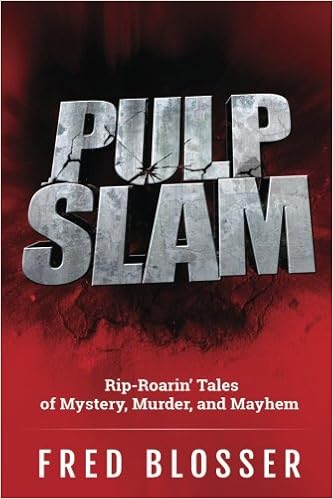 Pulp Slam: Rip-Roarin' Tales of Mystery, Murder, and Mayhem: Fred Blosser, Bob McLain: 9781683900733: AmazonSmile: Books Pulp in Your Face!
In thirteen take-no-prisoners pulp yarns, Robert E. Howard scholar Fred Blosser caroms from the Old West to the noirish streets of urban America, and then beneath the earth itself, into a primitive world of savagery, to slam you silly with the best in pulp fiction.
By bullet and sword, fist and fortune, Blosser's square-jawed yet often brutal heroes face down the worst that evil has to offer:
Ringo and Horn blow away bootleggers, outlaws, Mafia thugs and assassins, and other lowlifes, from the backstreets to the backwoods
Commander Manta and Agent Gila battle the hallucinogenic horrors of a would-be world conqueror in Washington, D.C.
Dax the Go-Run struggles to survive in the savage, subterranean world of Kaal-Dur, as he goes in quest of a captive princess
All this, and hitmen vs Cthulhu, too. You can't go wrong with hitmen vs Cthulhu.
Plus, Blosser serves up a quintology of non-fiction analyses of such pulp topics as Dashiell Hammett's "Nightmare Town" and the Mafia novels of Richard Posner.
Get Slammed!
How the Bristol Sessions Created Country Music
How the Bristol Sessions Created Country Music: During two weeks in 1927, a group of singers gathered at a recording studio in a renovated hat warehouse in Bristol, Tennessee. Johnny Cash once called what happened next “the single most important event in the history of country music.”
Or Maybe You Do
13 Things You May Not Know About Bob Dylan: Bob Dylan is a legend of legends in the music world. He is rock music's greatest poet. He's sold millions of records and albums and his live concerts have been unforgettable events since the sixties. In 2008, Bob was awarded a Pulitzer Prize Special Citation. Now, as if his career hadn't been incredible enough already, he won the 2016 Nobel Prize for Literature. Okay, let's take a look at a few other interesting facts about Mr. Bob Dylan.

Subscribe to:
Posts (Atom)