 Peggy Gaddis, Woman of Fire, Cameo Books, 1952
Western Musings: A second look at a waning genre.
This new blog will be featuring reviews of forgotten western novels and short stories in an attempt to call attention to worthy works from the past. Check it out.
Scranton man charged with choking woman over iPad passcode: SCRANTON — A city man faces charges after police said he choked a woman Wednesday because she changed the passcode on her iPad.
 As a fan of Richard Wormser's work, I was honored to write the introduction to this Stark House twofer. I don't want to say much about the plots or the books or how I got my hands on one of them, since that's what I cover in the introduction. But I'll say a little to give you a hint of why you should read them.
I won't go so far as to say that the plot of The Body Looks Familiar is unique, but I'll bet you haven't read anything like it in years, if ever. And it raises the question in my mind about whether a book can be noir and not noir at the same time. That question isn't answered in the intro, by the way. You'll have to read the book and decide for yourself. The book was a Dell First Edition, although it originally appeared in condensed form in Cosmopolitan.
The Late Mrs. Five was a Gold Medal novel, and it's a nice little man-on-the-run story, set apart from many others of its type by it's setting, a very small town where there aren't many places for a man on the run to run or to hide. There are some mighty big coincidences in this one, but that just made the book more fun for me.
Stark House is doing a fine job of bringing forgotten writers back into print. This one will be available in January, but you can preorder it now so you won't forget.
NY Daily News: Danielle Darrieux, a prolific French actress whose movie and theater career spanned eight decades, has died. She was 100.
One of France's best-loved actresses, Darrieux appeared in dozens of plays and more than 100 films during her long career.
Hat tip to Jeff Meyerson.
 Elizabeth Gill, Young Sinner, Cameo Books, 1953
30 Essential Mystery Authors: Think all mystery books are the same? Think again. Thrillers, suspense, crime novels, detective fiction - whatever you call them, mystery books make for some of the most exciting literature out there. The mystery genre has been around for over two centuries, with pioneers like Sir Arthur Conan Doyle, Wilkie Collins, Edgar Allan Poe and G.K. Chesterton leading the way. From real-life spies (John le Carr, Ian Fleming, and Graham Greene) to politicians and journalists, mystery authors come from all walks of life and so do their protagonists. From elderly spinster Miss Marple and hard-drinking P.I. Phillip Marlowe, to dashing spy James Bond and medical examiner Dr. Kay Scarpetta, the mystery genre spans far and wide. Whether it's Victorian era crime you're after, or contemporary psychological thrillers are your thing, enjoy our list of essential mystery authors.
Houston Chronicle: The First Bank of Alvin has been home to alligators for nearly half a century. In 1969, a rice farmer donated three 6-inch gator hatchlings to the bank, to live in its goldfish pond, according to an Associated Press story, published in 1983. The trio - J. Paul Gator, Mitzi Gator and William Teller Gator - soon grew to be about 7 feet long, and became a major attraction for locals. The goldfish didn't last long.
Great article, excellent video. This is, of course, where I've been banking since moving to Alvin in 1983.
“Bayou City Breakdown” (by Susan Perry Benson) | SOMETHING IS GOING TO HAPPEN: Susan Perry Benson debuted in EQMM’s Department of First Stories in July 2013. A native Houstonian and a frequent contributor to the Houston Chronicle and Texas Magazine, she had already moved to North Carolina by the time she turned her pen to fiction, but she continues to have close ties to Houston. In this post she shares some thoughts about Hurricane Harvey, which made landfall near Houston on August 25, 2017. EQMM salutes all of those who have weathered this season’s hurricanes and are bravely rebuilding their cities and towns. And we thank Susan for letting us see the catastrophe from the perspective of someone to whom it is deeply personal. The author’s next story for EQMM will appear in our March/April 2018 issue.—Janet Hutchings
 Gene Harvey, A Girl Called Joy, Cameo Books, 1951
 I know what you're saying. You're saying, "How can a brand-new book be forgotten?" Well, I'm not saying it's been forgotten by current readers. I'm saying that even the author, Robert Silverberg, had forgotten it. The short version is that he wrote The Emperor and the Maula, a 30,000 word novella for a publisher as part of a multi-author project that never came to fruition. Silverberg eventually sold the story again by cutting it in half and selling it to a space-opera anthology. Then he forgot about it until one day he happened to run across the original on his computer's hard drive. He read it, liked it, and decided to sell it again, this time in is almost original version, with the difference being that he added an ending that was more conclusive than the original one. It's all in Silverberg's introduction, which is not to be missed.
I enjoyed the novella. Although it was written about 1992, it reminded me very much of the kind of SF I liked to read much longer ago than that. It's an old story in a new form, the story of Scheherazade and the thousand nights and a night as space opera. Laylah Walis is the teller of the tales, and she's telling them to the emperor of the Ansaar. Her purpose is to stay alive from night to night, but also to tell him about her world of Earth, conquered by the Ansaar, and about the things that happened there after the conquest. And also to tell him about her travels through parts of the Ansaar empire. The story's old-fashioned in the best sense, with a real sense of wonder (and bushels of adverbs), along with Silverberg's usual storytelling panache. Since Silverberg isn't writing fiction anymore, it's a real gift to have something new from him. Check it out.
20 Beautiful Color Photos of Julie Andrews in the 1950s and 1960s: Singer and actress Julie Andrews was born Julia Elizabeth Wells on October 1, 1935, in Walton-on-Thames, Surrey, England. Andrews has endured as a popular star of stage and screen for many decades. She came from a musical family; her mother was a pianist and her stepfather, from whom she took her surname, was a singer.
 Alan Marshall (Donald E. Westlake), All About Annette, Midwood, 1960
Bouchercon was great. I missed seeing some people I wanted to see, but I got to visit with a lot of friends. My panels were all well received, and in fact turned out even better than I could have hoped. My daughter, Angela, was there, and she took good care of me. We visited the CN Tower, the railroad museum, and Casa Loma. Photos to follow. Maybe.
 Blood from the Mummy's Tomb is one of the later Hammer horror films, and not one of the best, but when it showed up on TCM, I recorded it and took a look. It's based on Bram Stoker's Jewel of the Seven Stars, and it's not a real mummy movie. That is, there's no wrapped up menace. Instead we get Valerie Leon, who's Tera, the sorcerous woman placed in a tomb in some sort of suspended animation by Egyptian priests, who then cut off her hand and throw it to wild dogs. Not that it does them much good, as they all wind up with their throats torn out. There are a good many torn-out throats in the movie.
Many years after the entombment, Prof Fuchs (Andrew Keir) leads an expedition that discovers Tera. While he's in the tomb, his wife back in England dies in childbirth, and the child dies, too. But she revives when Fuchs speaks the name Tera. She grows up to look just like Tera, and she's also played by Valerie Leon. She has a red scar on her wrist. And Fuchs just happens to have smuggled Tera's body and sarcophagus into his basement. Don't ask how. On his daughter's birthday, he gives her a ruby ring taken from Tera's severed hand. You can probably guess the rest, as the new Tera is gradually taken over by the old one, who uses the new one to get revenge on the members of the expedition and to take and artifact from each one. The artifacts will allow her full return to live when all are gathered.
There's an evil member of the expedition who's trying to facilitate Tera's return, and there's the new Tera's boyfriend who's trying to help her fight the takeover. Lots of people die, and the ending of the movie is either satisfactory or not, depending on how you like ambiguity.
Blood from the Mummy's Tomb isn't great, and it's pretty slow, but it's passable Halloween entertainment.
The New York Times: Richard Wilbur, whose meticulous, urbane poems earned him two Pulitzer Prizes and selection as the national poet laureate, died on Saturday in Belmont, Mass. He was 96.
Hat tips to Barry Ergang and Jeff Meyerson.
The New York Times: Roy Dotrice, a British stage, film and television actor who began performing as a prisoner of war in Germany and worked in Britain and America for six decades, notably in one-man shows portraying Abe Lincoln, the diarist John Aubrey and other historical figures, died on Monday at his home in London. He was 94.
Hat tip to Jeff Meyerson.
Elizebeth Friedman, America's Unsung Wartime Codebreaker: An American pioneer in the field of cryptology—the study of writing and solving secret codes—William Friedman is known for his distinguished career as an expert codebreaker with the U.S. Army during World Wars I and II. But although Friedman is one of the biggest names in cryptanalysis—he coined the word itself—historians often skip over the fact that his wife, Elizebeth, was every bit as skilled a codebreaker. Her accomplishments have been (sometimes deliberately) kept from the spotlight.
 J. X. Williams, Sin Street Hippie, Nightstand Books, 1968
 Harry Whittington (James W. Lampp)*, Love Cult, Lancer, 1962
*Harry Whittington wrote a lot of books, but he didn't write this one. Here's the whole confusing story.
 Neil Curtis, The Land of Esa, Curtis Books, 1952
 Jack Ehrlich wrote a lot of dandy paperbacks, both westerns and crime novels, although he's almost entirely forgotten now. One of the most amazing of them is Bloody Vengeance. I think I wrote once that I didn't know if Ehrlich was serious in this book or if it was a parody of the series like The Executioner and its many imitators. Either way, reading it is quite an experience, and it's just as relevant now as it was back in 1973.
Here's the premise. Some cops decide to take the law into their own hands. If the law's not convicting the scum on the streets, why not just kill them? What if this worked out so well that other cops took up the idea? What if it became a movement that spread across the country? What if the instigator if the whole thing became a powerful political figure and the head of a powerful political movement?
There are a couple of ways to take the book, as I said, but whichever one you choose, I think you'll agree that the book is very well done and pretty dang scary. You can tell yourself that it can't happen here, but don't you have to wonder a little? Check it out and see what you think.
 Leonard Fischer, Let Out the Beast, News Stand Library, 1950
Iron Ladies of the American Railroad: Travel the West on historic railroads and discover how women helped build a nation.
 Anne Powers, Ride East! Ride West!, Ace, 1960
My oncologist gave me the okay to attend the Bouchercon in Toronto. I think I'm up to the trip, but there's only one way to find out for sure. Assuming I get there and survive, I'll be back in Alvin late next Monday. The blog will proceed mostly as usual since I've scheduled stuff to appear. I won't be available by email most of the time, but I'll try to check it occasionally. My daughter, Angela, was planning to be in Toronto as well, but the fires in and around Sonoma County might wreak havoc with those plans. I hope not, though.
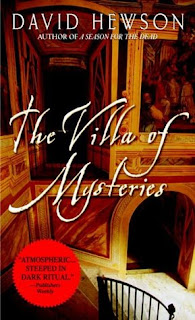 After reading a review of this book by David Vineyard on Steve Lewis' Mystery*File, I thought I'd give it a try. It's a considerably complexly plotted mystery set in Rome with a big cast of characters that includes cops (Costa, Peroni, Falcone), a pathologist (Teresa Lupo), the anti-Mafia squad, Mafia members, revenge, ancient rituals, buried secrets, and probably more that I'm forgetting.
Things are set in motion when a pair of Ugly American tourists discover a bog body. The body is at first wrongly identified by Lupo as being as much as 2000 years old, but it's not. It's only 17 years old, and the girl is soon identified correctly. Then a mother comes to the police because of the apparent abduction of her daughter. That's when things get complicated. There's a series of revelations at the end of the novel, one after another, many of them surprising.
After reading a review of this book by David Vineyard on Steve Lewis' Mystery*File, I thought I'd give it a try. It's a considerably complexly plotted mystery set in Rome with a big cast of characters that includes cops (Costa, Peroni, Falcone), a pathologist (Teresa Lupo), the anti-Mafia squad, Mafia members, revenge, ancient rituals, buried secrets, and probably more that I'm forgetting.
Things are set in motion when a pair of Ugly American tourists discover a bog body. The body is at first wrongly identified by Lupo as being as much as 2000 years old, but it's not. It's only 17 years old, and the girl is soon identified correctly. Then a mother comes to the police because of the apparent abduction of her daughter. That's when things get complicated. There's a series of revelations at the end of the novel, one after another, many of them surprising.
This is a literate but overlong thriller. Excellent atmosphere and local color, along with some genuine creepiness. Check it out.
A Literary Tour of London: Like the city itself, the list of books where the plot threads through London's crowded streets is immense and rather overpowering. Where does one start when recommending books set in the city? We are assuming you have already read enough Dickensian literature although Oliver Twist is always worth revisiting. We're deducing Sherlock Holmes is too obvious for this reading list.
 Gertrude Schweitzer, The Obsessed, Gold Medal, 1950
Sonny & Cher: 30 Lovely Photos of American Singer Couple in the 1960s: Sonny & Cher were an American pop music duo, actors, singers and entertainers made up of husband-and-wife Sonny and Cher Bono in the 1960s and 1970s. The couple started their career in the mid-1960s as R&B backing singers for record producer Phil Spector.
 What do you think when you see a the title of a Hollywood movie like The True Story of Jesse James? Maybe I’m just a cynic, but I think that probably everything I see in the movie is going to be pretty far from the truth, and that turns out to be the case with The True Story of Jesse James.
Robert Wagner is Jesse, who sports the definitive 1950s haircut. Jeffery Hunter is Frank, whose haircut is nearly as good.
Now I’ll digress, if I haven't already. Not long ago I reviewed Black Bart a pretty dang good 1940s western with even less historic material than this one. It's more fun, too. But that’s not the point. The point is that the climactic scene of Black Bart seems to have been pretty much borrowed intact by William Goldman for Butch Cassidy and the Sundance Kid. I couldn’t rouse any comments about that on the blog post at the tme, but maybe somebody will speak up now.
To continue the digression, the opening of The True Story of Jesse James is the Northfield raid, followed by a chase scene organized by the Remington (why not call it Pinkerton if this is the true story?) detective agency. The chase shows huge numbers of men chasing Jesse and Frank, and it looks and ends pretty much just like a famous scene in, you guessed it, Butch Cassidy and the Sundance Kid. You can see a tiny bit of it in the trailer. I think Goldman committed another homage in his movie. Anybody else want to say something? I’d sure like to get some more opinions on this.
Now back to our regularly scheduled review. Wagner and Hunter get to do a couple of shirtless scenes, which surely helped sell the movie to teen girls in the ‘50s, so there’s that. It’s not a bad movie, but in spite of that and Cinemascope and its good production values, it never really rises above the pack. And it sure never gets too close to the truth. Beyond Hunter and Wagner, there’s a good cast that includes Hope Lange, Agnes Moorehead, John Carradine, Allan Hale, Jr., and Frank Gorshin. I liked the blind guy at the end who apparently makes up “The Ballad of Jesse James” on the spot and sings it. I had a little cardboard 78 of this song when I was a kid, and I sang it relentlessly. So I grew up with the legend of Jesse as the Robin Hood of the West, which the movie perpetrates against all the historical evidence. But to paraphrase a line from The Man Who Shot Liberty Valance, when the truth becomes legend, we might as well sing the legend. The Kingston Trio did a great version of the song in the early ‘60s to lead off their first album with John Stewart replacing Dave Guard. The KT was never the same for me, but I like their version of the song, anyway.
abc7ny.com: Y.A. Tittle, the Hall of Fame quarterback and 1963 NFL Most Valuable Player, has died. He was 90.
Hat tip to Jeff Meyerson.
abc7ny.com: Chloe Bennett and Timothy Watterreus were busy preparing for their wedding when Hurricane Harvey struck in August. But like many Houstonians, their plans were put on hold by the destructive storm.
Hat tip to Jeff Meyerson.
Pittsburgh Post-Gazette: Jimmy Beaumont, the golden-voiced singer of the Skyliners, died Saturday in his sleep at his home in McKeesport at age 76 after a career that lasted nearly 60 years.


 As a fan of Richard Wormser's work, I was honored to write the introduction to this Stark House twofer. I don't want to say much about the plots or the books or how I got my hands on one of them, since that's what I cover in the introduction. But I'll say a little to give you a hint of why you should read them.
 I know what you're saying. You're saying, "How can a brand-new book be forgotten?" Well, I'm not saying it's been forgotten by current readers. I'm saying that even the author, Robert Silverberg, had forgotten it. The short version is that he wrote The Emperor and the Maula, a 30,000 word novella for a publisher as part of a multi-author project that never came to fruition. Silverberg eventually sold the story again by cutting it in half and selling it to a space-opera anthology. Then he forgot about it until one day he happened to run across the original on his computer's hard drive. He read it, liked it, and decided to sell it again, this time in is almost original version, with the difference being that he added an ending that was more conclusive than the original one. It's all in Silverberg's introduction, which is not to be missed.
 Blood from the Mummy's Tomb is one of the later Hammer horror films, and not one of the best, but when it showed up on TCM, I recorded it and took a look. It's based on Bram Stoker's Jewel of the Seven Stars, and it's not a real mummy movie. That is, there's no wrapped up menace. Instead we get Valerie Leon, who's Tera, the sorcerous woman placed in a tomb in some sort of suspended animation by Egyptian priests, who then cut off her hand and throw it to wild dogs. Not that it does them much good, as they all wind up with their throats torn out. There are a good many torn-out throats in the movie.

 Jack Ehrlich wrote a lot of dandy paperbacks, both westerns and crime novels, although he's almost entirely forgotten now. One of the most amazing of them is Bloody Vengeance. I think I wrote once that I didn't know if Ehrlich was serious in this book or if it was a parody of the series like The Executioner and its many imitators. Either way, reading it is quite an experience, and it's just as relevant now as it was back in 1973.
 After reading a review of this book by David Vineyard on Steve Lewis' Mystery*File, I thought I'd give it a try. It's a considerably complexly plotted mystery set in Rome with a big cast of characters that includes cops (Costa, Peroni, Falcone), a pathologist (Teresa Lupo), the anti-Mafia squad, Mafia members, revenge, ancient rituals, buried secrets, and probably more that I'm forgetting.
  What do you think when you see a the title of a Hollywood movie like The True Story of Jesse James? Maybe I’m just a cynic, but I think that probably everything I see in the movie is going to be pretty far from the truth, and that turns out to be the case with The True Story of Jesse James.


