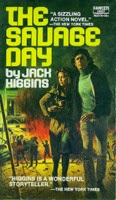
 The Savage Day was the first book I read with the Jack Higgins name on it, and I was immediately sold on the author. I didn't realize that he (actually Harry Patterson) was also Hugh Marlowe and that I'd read a novel by him earlier. However, after I became a fan, I wasn't so easy to fool again. When I started reading a book by James Graham (A Game for Heroes), I knew within a couple of pages I'd found another Harry Patterson pseudonym.
But I digress. Let's get back to the book at hand, which is one of my favorites by Patterson under any name. Simon Vaughan is a gunrunner who's in prison when the Brigadier gets him out to take on a job for the British. He wants Vaughan to work with his fellow gunrunner to recover a lot of British bullion that the IRA has hijacked. To do this he has to help with running some guns for the IRA. He's to assist a young man named Binnie and an American woman named Norah Murphy. Binnie is one of those deadly gunmen who turn up in Higgins' work with regularity. He's a romantic idealist who really believe in the struggle.
Naturally nothing goes smoothly. The first run is hijacked by Frank Barry, a bomb-happy Provo, who's broken off from the IRA, thinking them too easy on kids and civilians. The object of terrorism is to cause terror, and killing innocents tends to do that. Many complications ensue, with lot of chases and escapes and other thrills. A lot of people die, good and bad. There's a good surprise at the end, too.
The Savage Day is well-written in a deceptively simple style that manages to carry a lot of emotional weight. Highly recommended.
 There are two thriller writers whose work never fails to give me pleasure no matter how many times I reread their books. One is Alistair MacLean; the other is Jack Higgins. Not long ago I was in the library looking over their shelf of sale books, and I saw a three-in-one volume of Higgins' work. The books included in it are The Last Place God Made, The Savage Day, and Toll for the Brave. I have all three of them in their first U.S. paperback editions, but how could I pass this up for a buck? The answer: I couldn't.
The Last Place God Made is set in Brazil in the late 1930s. Neil Mallory is a bush pilot who's finally put together enough money to get back to England. Unfortunately for him, it's stolen by a prostitute and Mallory has to accept a job from Sam Hannah, another pilot, who has a contract to deliver mail and perform other services for the government. Hannah was an Ace in WWI, and he's the best pilot Mallory's ever seen. It's quite lucky for him that Mallory came along because he desperately needs another pilot to help him. Without help, he'd lose his contract.
What ensues is high adventure in the vein of a western novel, with the indigenous people this time being Brazilian. They've attacked a church, killing a number of nuns, two of whom are unaccounted for. Another nun, along with the beautiful sister of one of the missing women, shows up, and Mallory and Hannah are drafted to go to the church and try to find the women.
There's a lot of flying, plenty of fighting of all kinds (though I don't recall either Mallory or Hannah using a bow as depicted on the cover of the first Fawcett paperback). More than once in his novels, Higgins uses a younger man and an older, slightly corrupt, one paired together in a dangerous enterprise. It seldom works out well.
If you like good writing and just plain entertaining fiction, you can't go wrong with Higgins, and that certainly holds true for The Last Place God Made.
 Some of you will understand perfectly when I say that I remember quite well pulling this book off the shelf at a little used-book store in Abilene, Texas, back in the early '70s. I must have known at the time that Hugh Marlowe was in reality Jack Higgins/Harry Patterson/James Graham, or else the memory wouldn't have stuck with me.
Sean Rogan is in prison for his political crimes, but he was a hero in WWII, having saved the life of Inspector Vangbrugh, now of Scotland Yard. Rogan escapes from prison and agrees to help out the IRA one more time, but only because of the pleading of Colum O'More, who's dying of cancer. The help involves pulling off a Big Caper, and much of the book goes into the planning and execution of the caper. Besides Rogan, a corrupt cop, a couple of hardened criminals, an alcoholic accomplice, a scheming solicitor, and a beautiful woman are involved.
You might know where the plot's headed, but there are crosses and double-crosses along the way, along with a nice surprise or two. Marlowe's descriptions of weather and landscape are as spare and poetic as ever, and the book is an entertaining way to spend an evening.
One thing needs to be said. Many of you know Lachman's Law, which states, "Never buy a book with a swastika on the cover." This one's different, however, as the only Nazis involved are mentioned briefly in flashbacks to WWII. So although there's a swastika on the cover and this book was published at the height of the swastika-on-the-cover phase, the image has nothing to do with the contents.


